
📧 Email Marketing – Detailed Explanation
1. Definition
Email marketing is the practice of sending commercial or informative messages via email to a targeted group of people.
It is used to promote products/services, build relationships, and nurture customer loyalty.
Unlike social media where reach depends on algorithms, with email marketing you directly land in your audience’s inbox – making it one of the highest-ROI channels.
2. Importance of Email Marketing
- 💰 High ROI → On average, $1 spent on email marketing can return $36–$42.
- 🎯 Direct & Personal → Messages are personalized with the customer’s name, preferences, or behavior.
- 🌍 Wide Reach → Almost everyone has an email address.
- 🔄 Automation Friendly → Emails can be automated (welcome series, reminders, promotions).
- 📊 Measurable → Open rate, click rate, and conversion can be tracked.
- 🔒 Owned Channel → Unlike social media, you control your subscriber list.
3. Types of Email Marketing Campaigns
- Promotional Emails
- Announcing sales, discounts, new products.
- Example: “Get 30% off this weekend!”
- Transactional Emails
- Sent after customer actions (order confirmations, receipts, password resets).
- Informational Emails
- Company updates, newsletters, product launches.
- Welcome Emails
- Sent to new subscribers/customers to introduce your brand.
- Drip Campaigns (Automated Series)
- Pre-scheduled emails based on customer journey (e.g., abandoned cart → reminder → discount).
- Re-Engagement Emails
- Target inactive customers with special offers or updates.
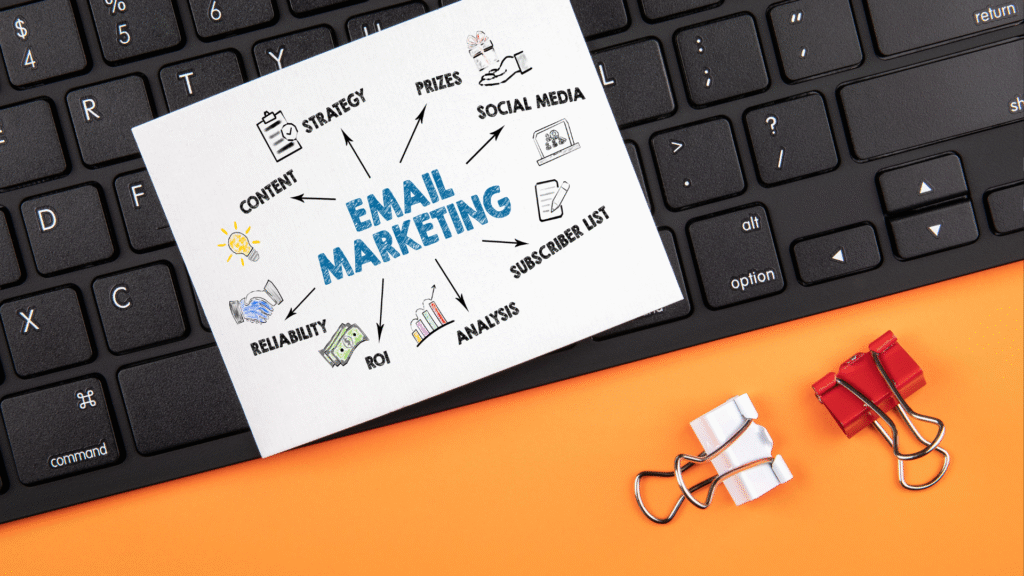
4. Steps in Email Marketing Process
- Build an Email List
- Collect subscribers via sign-up forms, pop-ups, lead magnets (eBooks, free trials).
- Segment the Audience
- Divide based on demographics, behavior, interests (e.g., new customers vs loyal customers).
- Create Engaging Content
- Strong subject line, personalized message, clear CTA (Call to Action).
- Design Emails
- Use responsive designs that look good on mobile and desktop.
- Send at the Right Time
- Timing affects open rates (e.g., weekdays mornings often perform best).
- Track & Optimize
- Monitor open rate, click-through rate (CTR), bounce rate, unsubscribe rate, conversions.
5. Key Metrics in Email Marketing
- Open Rate → % of people who opened the email.
- CTR (Click-Through Rate) → % of people who clicked on links inside the email.
- Conversion Rate → % of people who completed the desired action (purchase, signup).
- Bounce Rate → Emails that failed to deliver.
- Unsubscribe Rate → % of people who opted out.
6. Email Marketing Tools (Popular Platforms)
- Mailchimp
- HubSpot Email Marketing
- SendinBlue (Brevo)
- Constant Contact
- GetResponse
- Klaviyo (popular for e-commerce)
These tools help with automation, design templates, analytics, and list management.
7. Best Practices for Email Marketing
✅ Personalization – Use customer names & tailored recommendations.
✅ Catchy Subject Lines – Short, clear, and curiosity-driven.
✅ Mobile Optimization – Over 60% of emails are opened on smartphones.
✅ Segmentation – Don’t send the same email to everyone; customize by interest.
✅ Strong CTA – Clear button like “Shop Now” or “Sign Up Today.”
✅ Avoid Spam Triggers – Don’t overuse words like “FREE!!!” or send too frequently.
✅ Test & Improve – A/B test subject lines, designs, sending times.
8. Benefits of Email Marketing
- Builds long-term customer relationships.
- Generates high sales with low cost.
- Drives traffic to websites or landing pages.
- Encourages repeat purchases & loyalty.
- Works well alongside other digital marketing channels.
9. Challenges in Email Marketing
- Deliverability issues (emails landing in spam).
- Subscriber fatigue (too many emails → unsubscribe).
- Standing out in crowded inboxes.
- Data privacy regulations (GDPR, CAN-SPAM).
10. Future Trends in Email Marketing
- AI & Automation → Smarter segmentation, AI-written subject lines.
- Interactive Emails → Surveys, polls, shopping directly inside emails.
- Hyper-Personalization → AI-driven recommendations.
- Integration with CRM & E-commerce → Personalized product suggestions.